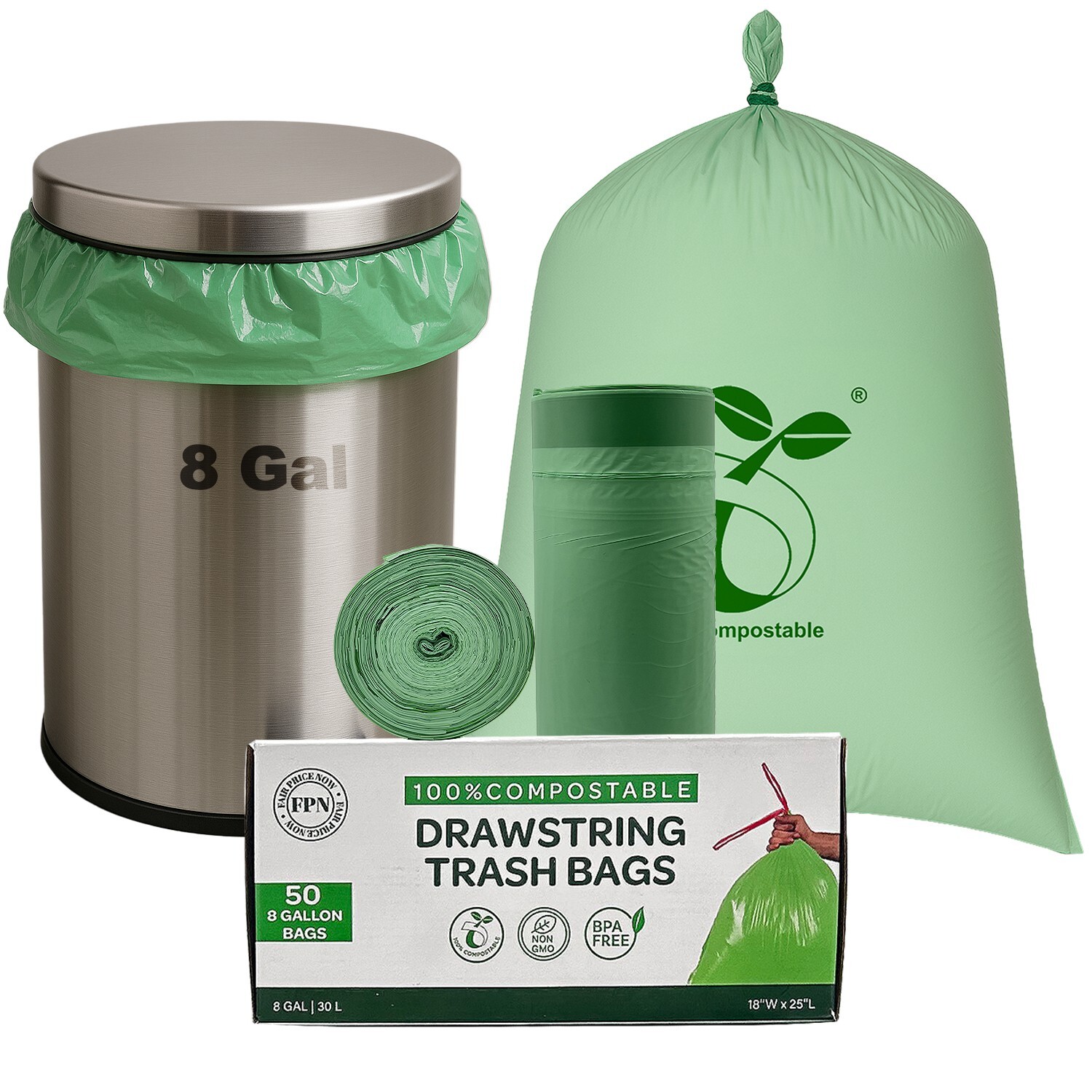

Photos from current listings. Actual item, color, and included accessories may vary.
Compostable Garbage Bag Buying Guide
Compostable garbage bags are engineered to break down in commercial composting facilities, but their real-world performance hinges on certified material chemistry (PLA/PBAT/starch blends) and thickness. The key trade-off is between guaranteed compostability under ASTM D6400/EN 13432 and the tear/puncture resistance of conventional polyethylene. Choose certified compostable bags with a minimum 0.8 mil thickness for food-scrap duty; skip thin, uncertified 'degradable' bags that fragment rather than biodegrade.


At a glance
- Category
- Household Cleaning & Paper Supplies
- Data updated
- Nov 18, 2026
Current offers
Highlights
- Certification separates true compostables from posers: ASTM D6400 (US) or EN 13432 (EU) prove full biodegradation in industrial conditions; 'degradable' bags only fragment into microplastics.
- Thickness is durability: 0.67 mil is the common economy floor and prone to tears; 0.8–1.0 mil handles food scraps and small bones without blowouts.
- Capacity sizing follows bin volume: 3 gal for countertop caddies, 8 gal for under-sink bins, 13 gal for standard kitchen tall bins, 30 gal for outdoor carts.
- Compostable bags require commercial facilities—home compost piles rarely reach the sustained 55–60°C needed for PLA/PBAT blends to disintegrate.
Best use cases
- Best fit: kitchen food-scrap collection for municipal curbside composting—pick 3 or 8 gal certified bags at 0.8 mil+ with a star-sealed or drawstring closure.
- Best fit: backyard composters using hot-pile methods—choose thinner 0.67 mil certified bags only if your pile sustains high temperatures; otherwise skip bags entirely.
- Wrong fit: lining outdoor wheeled trash carts for landfill disposal—compostable bags cost more and degrade poorly in anaerobic landfills; use standard PE bags there.
- Wrong fit: heavy or sharp waste (glass, bones, yard debris)—compostable film punctures easily; reserve these bags for soft food scraps and paper.
Buying tips
- Match gallon size to bin volume, not bag dimensions: a 13 gal bag fits a standard kitchen tall bin; an 8 gal bag suits a 7–8 gal under-sink bin without excess slack.
- Demand visible ASTM D6400 or EN 13432 certification on the box or bag—uncertified 'biodegradable' claims are unverifiable and often misleading.
- Choose 0.8 mil or thicker for food waste with moisture and small bones; 0.67 mil is acceptable only for dry, light compostables like paper and peels.
- Prefer star-sealed bottoms and drawstring or tie handles for leak resistance; flat-fold bags without sealed bottoms are more prone to seam failures.
Specs
| Certification | ASTM D6400 / EN 13432 |
|---|---|
| Thickness | 0.67–1.0 mil |
| Capacity | 3, 8, 13, 30 gal |
| Material | PLA/PBAT/starch blend |
Related searches
What to check before buying
- Measure your bin's height, rim diameter, and volume in gallons—bag capacity should match or slightly exceed bin volume for a secure fit.
- Confirm your local waste hauler accepts compostable bags in the organics stream; many industrial facilities require certified bags but some ban all film.
- Check bag dimensions (width x length) against bin rim circumference to ensure the bag drapes over the edge without slipping inside.
- Store bags in a cool, dry place away from direct sunlight—compostable film degrades prematurely with heat and UV exposure.
FAQ
Data sources: eBay / Amazon listings and product attribute feeds Data updated Nov 18, 2026.
Some links on this page are affiliate links. If you buy after clicking one, we may earn a commission at no extra cost to you. This does not change which products appear here or their order. Affiliate disclosure.